
From requirements to domain models, interface design, and architecture that scale
For iOS, Android, Flutter, and React Native engineers building production apps.

Follow a real project from briefing to architecture, then design stable domains, interfaces, and modular UI that scale.
Trusted by over 1,000 mobile engineers
Get the bundle
Only $89
Subscribe for free chapters
15-Day Money-Back Guarantee (no questions asked) • Instant access • Lifetime updates
✓ All platforms: iOS, Android, Flutter, React Native
✓ For interviews AND building production apps
Bundle includes
Single-volume edition + 3-part guided edition
30 chapters and 688 pages
PDF + ePUB formats
Quick Reference Guide
Lifetime updates
Get the complete content as a 3-part guided edition, organized by the stages of mobile system design.
It is built for focused learning and easier navigation across briefings, modular UI, and large-scale codebases.
All editions come in PDF and ePUB, so you can read however you prefer.

Also included: the single-volume edition
Same chapters as the 3-part set, combined into one book for uninterrupted reading and a single file on your device.

0. From Briefings To System Architecture (227 pages)
Turn vague requirements into a complete, structured, scalable architecture, while applying fresh, real-world-tested approaches to Dependency Injection and testing.
Learn how to navigate uncertainty, deliver a strong technical foundation from scratch, and build maintainable systems that support fast iteration.

1. Modular UI & UI Architectures (235 pages)
Build UI architectures that scale by designing modular, self-sufficient features.
Learn how to create reusable views that adapt to different navigation patterns, ensure components remain flexible and independent, and structure UI layers for long-term maintainability.
Covers key strategies for balancing reusability with clarity, reducing coupling, and improving testability.

2. Large-Scale Codebases & Design Systems (232 pages)
Learn how to implement a design system that balances flexibility with consistency, ensuring seamless UI scalability across teams and products.
Then, discover how to break down a growing codebase into maintainable modules, enforce clear boundaries, and prevent complexity from spiraling out of control.

When preparing for a job interview or navigating your daily work, you don't always have time to read an entire book.
That's why when you buy the book, you'll also get the Quick Reference Cheat Sheet!
It distills the most useful steps for turning vague prompts into clear designs, with tips for diagramming, naming, and coding under pressure.
These books are for mobile engineers who ship production apps and want the architecture to stay calm as features, teams, and traffic grow.
If you are making interface and domain modeling decisions that will shape how your app evolves, this fills the mobile system design gap most resources skip.
You'll get the most out of it if:
❝It has helped me crack some of the most difficult System Design interviews.
It's even helping in my current role where I'm heading the mobile division.❞
— @_thatabishek

Follow a feature from requirements to domain model, interface design, and modular implementation.
Each step is practical and mobile-specific, focused on boundaries, data flow, and contracts that keep teams moving.
The scenarios mirror real teams and evolving requirements, from small teams to large organizations.
You leave with tangible patterns you can apply the next day in interviews and production.
The book is suited for all mobile platforms.

Stop fighting unclear boundaries and brittle modules. Learn how to keep a growing codebase change-friendly so you can focus on shipping.
Make confident architecture decisions with limited information by choosing contracts, data flow, and ownership that scale.
This lets you make faster, safer decisions on interface design, domain modeling, and modularization.


System design is now expected in mobile interviews and in day-to-day senior work.
Use this book to practice clear problem framing, domain modeling, and interface design under real constraints.
Show that you can deliver app-wide solutions, not just isolated features.

Donny Wals
iOS engineer, Speaker, Author of Practical Concurrency and Practical Combine.
"This book takes a step back to focus on the core principles behind good system design for mobile apps, and really helps to peel back the layers of what good code design should look like."

Marie Denis
Entrepreneur, Women Make creator, former iOS engineer at Twitter.
"Overall, I found it user-friendly, easy to read. I particularly like the concrete project example, which realistically mirrors a day-to-day work scenario. The approach is practical."

Hugo Visser
Google Developer Expert for Android, Main robot at Little Robots
"If your team is struggling with code patterns or arguing about architectures, this book provides valuable advice to get back to actually shipping features."
Ready to apply these principles to your own app?
Get the bundle15-Day Money-Back Guarantee - no questions asked

I have a system design interview coming up for iOS in about 3 weeks. Anyone available to help me practice? I’ve been reading this https://t.co/hbUETCKrrj and it’s been very helpful :)
— Taylor Simpson (@phzytaylor) January 22, 2024
Exploring @tjeerdintveen's https://t.co/byhJdiTZiS for the second time as it updates. It's a valuable resource for mobile engineers at any level, significantly aiding my project work. Even received direct help from Tjeerd on an occasion! #MobileEngineering #iOS
— Edvinas Gestautas (@edvinasges) February 2, 2024

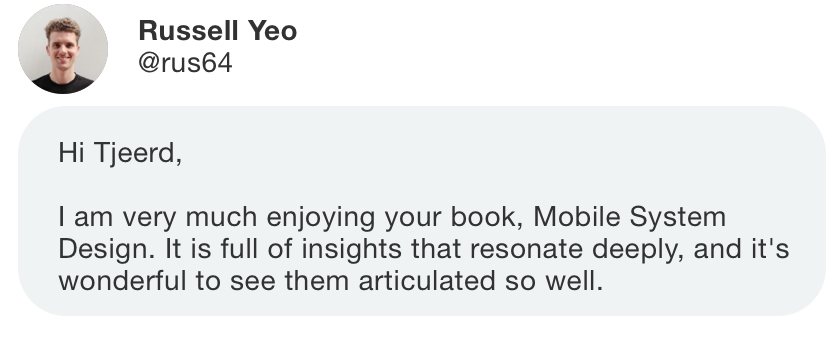
Tjeerd has put together the definitive book to building a mobile app for large and small companies alike.
Instant access to all editions (PDF + ePUB).
✓ 15-Day Money-Back Guarantee (no questions asked) • Instant Digital Access • Lifetime Updates
What you'll get:
Includes all of this:

What is System Design, is it UI related?
System Design is about technical design. It's about coming up with all the components, interfaces, and architecture necessary to make a mobile app work. This book will cover the technical design of various components across multiple abstractions and domains.
Is there UI in this book?
This is not a traditional "UI Book" where we cover components and how to style them.
However, the book does cover many important topics related to UI. Such as adding a design system to a pre-existing project (just like real life), delivering reusable components, component abstractions, and how to reason about UI architectures.
Is this book focusing on interviews or building an app?
It assists you with both. In this book we'll go over the processes of turning requirements into a robust feature all the way to a modular codebase. Along the way you'll learn mental models that you can apply to your own application and interviews.
This book is not a template for common approaches, however. The books' aim is to give you tools so you can solve any problem, not just pre-rehearsed problems.
This way, you can handle any problem that's thrown at you during the system design interviews.
I'm preparing for an interview. What should I read first?
Start with the Quick Reference Guide, included as a bonus when you buy the book. It offers concise, actionable tips to help you quickly prepare and feel confident.
Is this book for Android, Flutter, or iOS engineers?
All mobile engineers! That includes Android, iOS, Flutter, and Hybrid solutions such as React Native.
The book uses iOS and Swift as a vehicle to explain concepts and best practices. Where necessary, the book explains specific Swift keywords.
If you’re an Android engineer, rest assured that Swift reads similar to Kotlin in many ways. With little effort, you'll be able to understand the Swift code examples.
If I already make apps, is this book for me?
Absolutely. The book assumes you're already a developer working on apps, or about to become one. If you’re a senior or junior engineer, then this book is written for you.
I have never even made an app, is this book for me?
The book is aimed at people that have at least some experience in the app-development world. However, if you've never made an app before, this book will show you what the process entails.
Is this a programming book?
Sort of, but not really. The book covers the process of developing a mobile application. However, it's not a "code book". The book uses Swift to show concepts and how to implement something on a code-level. But it won't show you how to make a complete app from scratch.
It uses code as a vehicle to explain ways of thinking and how to get things done. But this book is more about mental models and avoiding pitfalls. It's about making better choices at every step of the process, from a requirement to a full-fledged, tested implementation.
Will there be a printed book version?
It is being considered. No promises yet!
Is this an eBook or printed book?
This is a digital eBook, provided in both ePUB and PDF formats. You’ll receive the complete book as a single volume, plus a 3-book structured edition, all available in both formats for flexible reading.
What editions do I get?
You receive the complete single-volume book plus the 3-part structured edition, in both PDF and ePUB formats.
What’s the difference between the complete book and the structured edition?
You get the same content in both versions, but the structured edition organizes the book into three focused books to make it easier to read and apply in stages. The single-volume complete book keeps everything in one file for uninterrupted reading, while the structured edition helps with step-by-step learning.
Does this book work on Kindle?
Yes, you can send the book's ePUB or PDF to your Kindle via Amazon's Send to Kindle. Then it will show up in your library. I recommend sending the ePUB version so you can adjust size and layout.
Do I need to read all three books separately?
You can read however works best for you. If you prefer a step-by-step learning approach, the structured edition helps you focus on each stage of mobile system design. If you like having everything in one place, the full book is available as a single volume.
Can I skip a chapter, or do I need to read them in order?
You can start wherever works best for you, but the real power of this series is that each book and chapter builds on the same project. By following the structured edition from start to finish, you’ll see how the concepts come together in a practical, real-world way. It's a journey from scratch to designing robust systems with confidence. That said, if you’re already experienced in certain areas, you can jump to the section that’s most relevant to you.
Is there different content in the structured edition?
The core chapters are the same as in the full book, but the structured edition includes exclusive introductions and conclusions for each part. These custom intros and outros provide extra guidance on how each section fits into the bigger picture, helping you learn and apply concepts more effectively.
What does the subtitle “Resourceful Engineering” entail?
Developing a mobile application has a wide range of topics, from building a small view to maintaining a giant modularized application using a variety of tooling. The term "system design" can encompass even more, from interviews, to architectures, to shared code solutions such as hybrid, a Rust core layer, or Kotlin Multiplatform.
With Resourceful Engineering we refer to a very common, yet local, process in an app codebase, which is 'getting requirements and having to deliver a solution, features, and various components'
In reality, this means you have to move forward despite not knowing all the answers. Making strong choices with limited information is key.
To be resourceful means to be making the best out of the situations with the limited resources that you have.
In this case, that means you will learn to make good decisions at each step of the feature development process. During this process, we’ll try to get all the answers, find the hidden details, and work in such a way, so that our code can adapt to new (unforeseen) requirements.
Can I generate an invoice after buying this book?
Yes! Read how on Lemon Squeezy's guide.
Help, I can’t afford this book!
If you’re a student or in an unemployed situation, contact me at [email protected], and we can talk options.
What if I buy it and don't like it?
Send an email to [email protected] within 15 days from the purchase and you will get a refund. No questions asked.
Book 0: From Briefings to System Architecture
Book 1: Modular UI & UI Architectures
Book 2: Large-Scale Codebases & Design Systems
The most comprehensive mobile system design resource for production work and interviews.
Built for real production work and interviews - not interview-only prep.
Typical price ranges and attributes vary by provider.
| Solution | Cost | Mobile-Specific | Apply to Your Product | Interview + Work |
|---|---|---|---|---|
| Online Courses | $300-500 | ❌ Often generic | ⚠️ Varies | ⚠️ Some |
| Bootcamps | $2,000-15,000 | ❌ Broad | ⚠️ Varies | ✅ Yes |
| System Design Books | $40-60 | ❌ Mostly backend-focused | ⚠️ Use-case focused | ⚠️ Harder to generalize |
| This Book Bundle | $89 | ✅ Mobile-Only | ✅ Extensive | ✅ Both |
Cost: $300-500
Mobile-Specific: ❌ Often generic
Apply to Your Product: ⚠️ Varies
Interview + Work: ⚠️ Some
Cost: $2,000-15,000
Mobile-Specific: ❌ Broad
Apply to Your Product: ⚠️ Varies
Interview + Work: ✅ Yes
Cost: $40-60
Mobile-Specific: ❌ Mostly backend-focused
Apply to Your Product: ⚠️ Use-case focused
Interview + Work: ⚠️ Harder to generalize
Cost: $89
Mobile-Specific: ✅ Mobile-Only
Apply to Your Product: ✅ Extensive
Interview + Work: ✅ Both
Less than $3 per chapter for complete mobile system design mastery — from interviews to production apps.

Tjeerd in ’t Veen is a mobile engineer who challenges the way we create mobile applications.
With over 25 years of experience developing features, including roles as a staff engineer at Twitter (now X) and as a mobile tech lead at ING international bank, he possesses expertise in developing mobile applications with scalability, adaptability, and robustness.
Tjeerd is the author of the highly-rated book Swift in Depth.
Connect with Tjeerd



All 30 chapters available now.
Instant access to all editions (PDF + ePUB).
✓ 15-Day Money-Back Guarantee (no questions asked) • Instant Digital Access • Lifetime Updates
What you'll get:
Includes all of this: